
A conversation with Pauline Njeim on lines, language, and going home
I first met Pauline back in Lebanon when she was still a student and had the privilege to witness her growth into the artist that she is today. In a conversation with her, learning about her process was a joy.

On Beginnings
NA. How did you start painting? What made you ‘you’ as an artist?
PN. Yes, I do remember. In my childhood, I was seven, eight maximum. I was playing with ropes, a lot of ropes, and I had the idea of drawing with them on the floor, making faces out of them. At that age the face was pretty basic, a circle, some hair, but at the end it was something nice, and my parents took a picture of it, they were so proud. Thinking about it now, that was my first piece of art. And as funny as it sounds, it did start with lines. Only lines. I'm figuring that out right now, actually, while I'm talking to you. […] After the ropes, I just kept enjoying painting and drawing on the side. Even at school I wasn't extroverted at all, I'm very extroverted now, but as a child I was so shy. I'd take a big piece of paper and a pen, go sit in a corner, keep a few friends, and that was it. With time I started actual painting classes, when I was ten or eleven, painting on fabric and on plates. Then I sold it. I sold all my stuff. […] And then I lost all the money on the way home. That was my first paid business, but I mean, who gives a ten-year-old money and expects her to come back with it? I don't even remember what happened to it, it was two hundred thousand Lebanese liras.
NA. Two hundred thousand Lebanese pounds, so that was around one hundred and thirty US dollars before the economic crisis.
PN. Exactly. And I was selling my stuff, so happy, and even older people were buying it, people from the university nearby. I was so happy about that, and then I got home and my mom asked, oh, you sold everything? And I said yes! Where's the money? I don't know. That's the funny story. […] Next thing I remember is leaving the second year of high school and transferring to technical school.
NA. Just so people follow, you're talking about the typical high school path, and by your second year you realized you didn't want those school subjects and went to a technical school instead.
PN. Yes, exactly. I grew up in a house where either path was fine, the traditional academic route or a technical one. By my second year, I was so overwhelmed with courses I knew I'd never use, so I switched and started graphic design right away, doing exactly what I wanted to do. I think my journey officially started there, but it had been building since I was a child, and I think it's partly genetic, honestly. My paternal grandmother did embroidery and used to teach me. My mom used to make ceramic flowers with clay, and we'd do it together. So, it came from both sides, and it built my identity over time. I did a master's in graphic design in Lebanon, then came to France and did a two-year master's in comic art.
NA. If you weren't an artist at all, and that includes graphic design, what would you have been?
PN. The answer might change every year, honestly. Last year, someone asked me and I said florist. The years before that I'd have said I'd always be a painter, an artist, something I love, no matter what. I don't know, it's different every year, but it always comes back to color, and to expressing feelings without saying them, because in art you communicate without talking. Avoiding conversation with people was kind of my thing as a child, so I started figuring things out on paper instead. That became my language.
NA. It's funny, because I would have assumed you'd say voiceover, storytelling. I remember you had this whole phase where you wanted to create and voice children's books.
PN. Yes! I think something kind of killed that. I went to an audition once in Lebanon, a voiceover for a game, and it wasn't my thing at all, they were casting for a war game where you have to scream, and that's not my voice-over energy. But if something ever comes up that's voiceover for children, that kind of thing, I'd genuinely be interested. I just never think of it as, you know, my actual job.
On the Line
NA. So, one-line art, your preferred medium. Walk us through it. What is it, for someone who doesn't know, and why that medium specifically?
PN. I experimented with a lot of styles over the years, and I found a piece of myself in each one, but I eventually settled on line-drawing because it's the truest way I have of expressing myself, on paper or digitally. Every single idea can start with a dot, and that dot becomes a line, and from there you can do a lot of things. You can sketch something realistic, or keep it simple and more abstract, and abstract is where more of the feeling lives, less of the reality. I like it because you can always modify the line, and you're never wrong. Whatever your hand does, it means something. There's nothing wrong with lines. Nothing. Even the thing someone else might call an error, a wobble, a deviation, you don't need to fix it in one-line drawing. You just find the strong point you actually needed to make it appear, and the rest is additional. You can keep it or build from it.
NA. And when you say one-line art, you specifically mean the uninterrupted stroke, right? Once your pen is on the paper, you don't lift it until you're done.
PN. I work in two versions. One is a true single line, I don't lift my hand off the paper until I'm finished, and if I do lift it, even by accident, that's it, the piece is done, I don't continue. The other lets me lift my hand on purpose, because I feel like this line needs to end here and a new one needs to start there. That's still one-line to me in spirit, each line is doing a different part of the same picture, just not literally continuous.
NA. What other media did you experiment with before landing here?
PN. I went through a phase of pure digital illustration during the first part of COVID, no paper first, straight to digital. Before that I was painting a lot, mostly acrylic, I'm still not fully comfortable with oil, it's a harder technique and you can mess everything up if you don't know it. I painted a lot in my early twenties, and it started with whatever I was feeling in my room. It's kind of funny, but it's almost always when I'm really sad, or really angry, or so happy there's nothing in between. On a normal day I don't even have the creativity to draw. It's the extremes that get me on the canvas.
On the Unfinished Story
NA. Is there any other form of art your work is influenced by? I can already see words and poetry lines mixed into your paintings, how does that happen?
PN. That really started once I did my comic art master's, that's when I began mixing text with image on purpose, to say more even when I'm not writing the words directly, tiny comic strips, tiny stories. I don't share most of them because I rarely finish them. I'll have all the ideas, I'll start writing, but it's a whole job to do everything yourself, writing and drawing and living your life at the same time. I can write first and draw after, but finishing takes so much time that things end up on pending. […] There's one project like that I'm still sitting with, and it's a hard one to admit is still unfinished. In 2020, right after the Beirut explosion, on the fifth of August, I was struggling with a lot of emotion and didn't know how to get it out. I saw the story of Alexandra, the youngest child killed in the blast, she was three, and I started writing. That same year I got accepted into the comic art program in France, and I brought the story with me and worked on it as my thesis. I started building it into an actual comic about Beirut, and it's still not finished. I haven't even reached the middle. I feel really sad about that.

NA. Yeah, you lost the momentum of the original thing you wanted to say. Would you say comic art is the medium you're still trying to master, you're just not there yet?
PN. Exactly that. I always find myself fully in the drawing, or fully in the writing, and when I try to combine them it suddenly feels like this huge job, like it's too much for one person. When I want to write, I write, and that feels complete on its own. When I want to draw, I draw. But merging them consistently, staying with one story long enough to finish it, that's the part I haven't mastered yet.
On Influences
NA. Is there a famous artist you're inspired by?
PN. I don't know if I'm inspired by artists so much as fascinated by them.
NA. Okay, let's rephrase then. What's one piece of art that's moved you a lot?
PN. Van Gogh, all of it, especially Starry Night. It's not even close to my own style, but whenever I look at his work I just feel something. It's not, oh, that's a nice painting, look at the technique, look at the colors, and that's it. It's more than that. I actually went looking for Starry Night at the Van Gogh Museum in Amsterdam once and was so sad to find out it isn't even there.
NA. Is there any art out there that feels close to what you do?
PN. There's a lot of modern artists on social media doing line work close to mine, but if you go back in time, there's Jean Cocteau. He was a poet and an artist, and he mixed his poetry with a very specific kind of drawing, using his own typeface as if the letters were lines themselves. That's close to what I'm doing, using lines that are full of story.
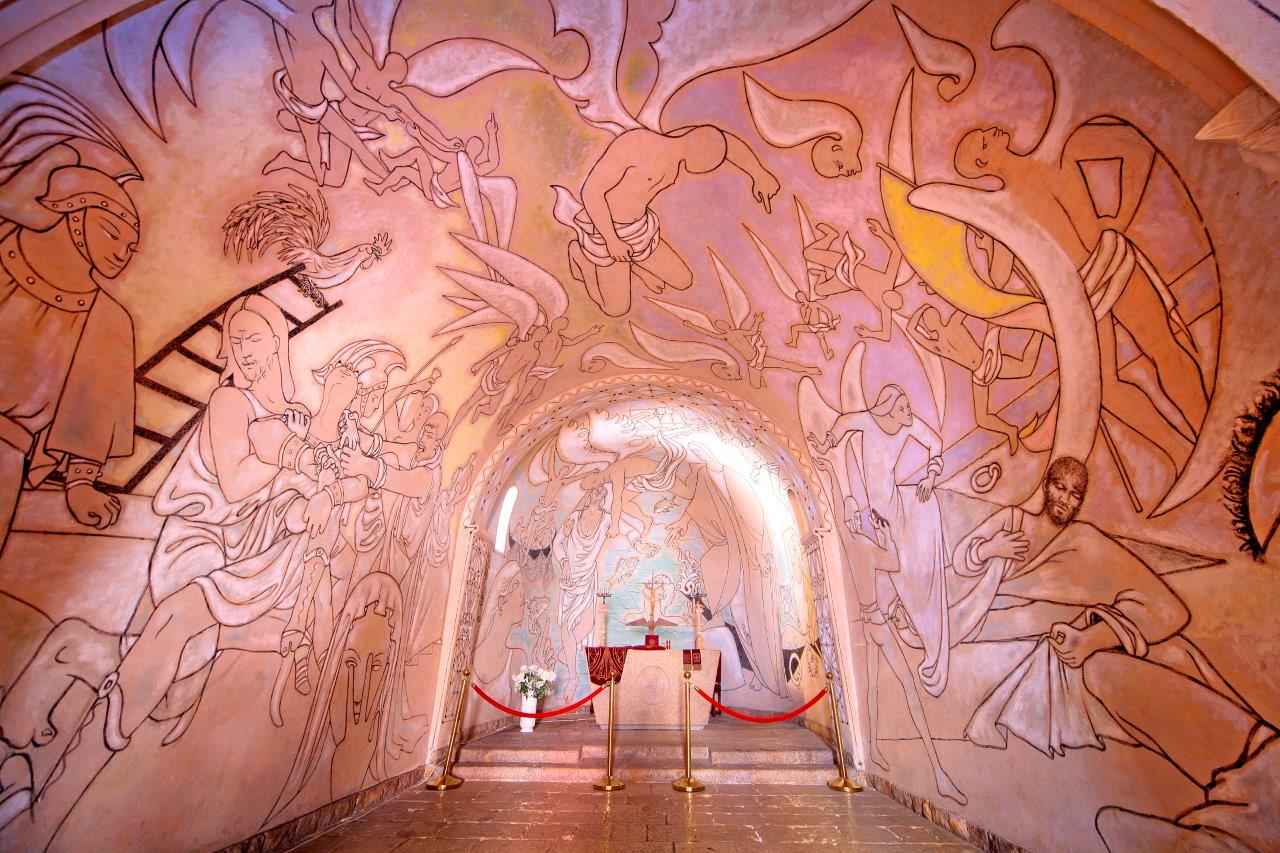 Interior of Chapelle Saint-Pierre by Jean Cocteau | Credit to Bonart.cat
On Being Arab
NA. Let's go back to the fact that you're Arab. Is there something in the culture, the textiles, the calligraphy, the ceramics you mentioned, that feeds into your work? I can see your logo has a flare of Mediterranean architecture, I don't know if I'm delusional or not.
PN. You're not delusional, no. Lebanon specifically holds so much art. It's in our homes, our floors, our windows, our culture, our coffee, our food. It's even in how we communicate with each other. I think we're a population that loves to mix and match, even with language, we don't stick to just one. Lebanon is a kind of mixed media, we take everything and create something out of nothing. It's inspiring just watching old people talk, or watching your own parents love you without ever really saying it out loud. My dad would give me an apple, I'd say I loved apples, and the next day he'd show up with a whole box. Our trauma made us creative, honestly.
NA. If your art were a genre of music, what would it be? If someone heard your lines instead of seeing them, what would play?
PN. Jazz, or blues. I love both, though I'm not sure everyone would hear that in the lines.
NA. That actually tracks, it's very close to improvisation, right? You're putting your line down with no plan, and that's basically what jazz is, someone improvising off whichever note came first.
PN. Yeah, that's interesting, actually. Yes, exactly.
The Fun Stuff
NA. Coffee or tea?
PN. Coffee. Lebanese coffee, Arabic coffee, of course. Tea is good for your health. Coffee is good for your soul.
NA. Is that why you have a painting with coffee mugs on it, the little cups?
PN. Yeah, I do a lot of coffee drawings, actually. I think it's an Arab bonding symbol, it's not just Lebanese, it's Turkish, it's everywhere. Every country has it in its own specific cup, and sometimes you'll find the exact same cup, just a different color, in a completely different country. It's something that unifies all of us. It makes your teeth yellow, but it makes your soul happy.

Click to purchase this artwork
How Do You Like Your Coffee by Pauline Njeim
NA. Alright, the big question. Which piece of yours would you buy, if you weren't Pauline? Out of the five that Arabiyon.art is featuring.
The one with the plane. I literally made this one when I was on the plane going to Lebanon. It started as a square drawing, and I'd buy this one over the rest, knowing I also love the coffee one, especially the one that came out of the bigger coffee and comic project.
NA. So why Take Me Home? Because you were on the plane when you made it?
PN. Yes. I was looking out the window, drawing what was on my mind, and what was on my mind was literally where I was sitting right then, and what I felt like from the inside, going home. You'll see a lot of tiny hearts all around, a line bonding all of them together. Family is the funding, because we don't go all the way back for the country alone. We love the country, we love everything, but if there's no one there from our family, we won't go. Sadly, as sad as that sounds. But we go for them.
 Click to purchase this artwork
Take Me Home by Pauline Njeim
NA. Last question. Where would you want your art to be hung in a room?
PN. In a happy place. Your happy corner, I don't know, on top of your most comfortable chair, or next to where you take your coffee. It depends on the piece, but somewhere near happy people.
Prints of Pauline Njeim's work are available now on arabiyon.art.


0 commentaire